
Murphy Institute's Gary Hoover Publishes New Book on Economic Promises

Who really gets ahead in a market-based economy? In his new book Ladder or Lottery: Economic Promises and the Reality of Who Gets Ahead, Gary "Hoov" Hoover, Executive Director of The Murphy Institute and Tulane Professor of Economics, sheds light on this essential question about placement on the social and economic scale: Is our economy a ladder or a lottery?
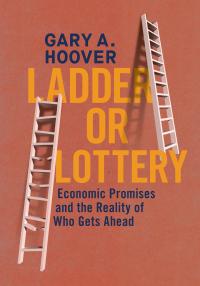
Drawing on his vast economic expertise and study of economic policy and its impact on wealth and income inequality, Hoov explores what this "social contract" requires of its citizens, and what it offers in return.
He argues that perspective matters immensely; while some believe socioeconomic positioning is a meritocracy based on industry, sacrifice, and dedication, others see the system as opaque and disconnected from anticipated outcomes. These actions and resulting outcomes are framed as the social contract between society as a whole and the individuals within it.
Hoov contends that in a well-designed system, the same input must repeatedly and predictably produce the same output. If those inputs yield unreliable results, a design flaw exists, and a redesign is required. At a minimum, users should be made aware of such flaws to ensure the failure is not unfairly attributed to the individuals themselves.
Drawing on his training in economics and mathematics, Hoov argues it is statistically inconceivable that 45 million individuals remain on the lower rungs of the economic ladder solely due to a "culture" or "pathology" that prevents them from climbing. If millions of people adhere to this social contract as intended but fail to see the promised results, the system functions more as a lottery than a ladder.
"In any other business context, when nearly 15% of operators could not properly use the system or product as created, there would be demand for a redesign at minimum."
— Gary "Hoov" Hoover
This "innovative resuscitation of the concept of the social contract," as William Darity Jr., Distinguished Professor at Duke University, describes, it “compels readers to engage in a vital rethinking of the nature of poverty and deprivation.” Darity calls the book "essential reading for all citizens, researchers, and policymakers who seek a more equitable society."
Ladder or Lottery challenges readers to examine whether playing by the rules and making the "right" choices truly guarantee upward mobility, regardless of one’s starting point. Rooted in the intersection of economics, race, and public policy, Hoov addresses the pressing issues of income inequality, healthcare, and the rise of AI to determine if our current social contract remains a viable ladder to economic security.
As Mitchell P. Smith, Director of the School of International Affairs at Penn State, remarks, Hoov "crystallizes an urgent reality" by laying bare “the widespread failings of the social contract in the United States. As this book authoritatively shows, our system's frequent disjuncture between effort and reward has become increasingly disruptive to societal cohesion.”
Ultimately, the book empowers individuals to decipher for themselves if improving one’s position on the economic spectrum is truly accessible to all, or rather a lottery in which only a few are destined to find success.
