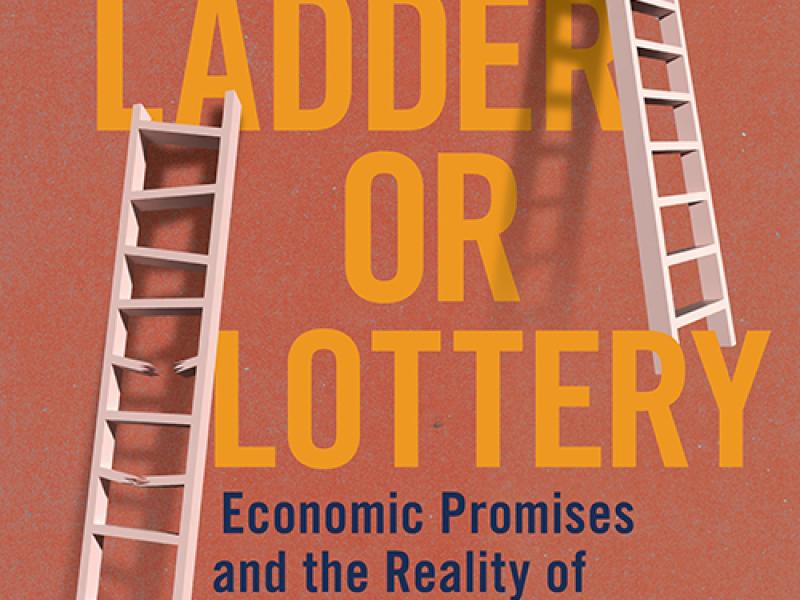
Who really gets ahead in a market-based economy? Find out with The Murphy Institute Executive Director and Tulane professor Gary Hoover as he shares his book with us, in conversation with local columnist Will Sutton.
This book asks a simple question: Is our economy a ladder or a lottery? Are people able to control their position on the economic spectrum by their actions? Some argue that, in our market-based economy, if you play by certain rules and make certain choices, you'll achieve upward mobility no matter what economic position you were born into.
Drawing on his vast economic expertise, Hoover explores what this "social contract" requires of its citizens, and what it offers in return. Hoover shows how civil unrest is often directly related to broken society-level promises, exploring protest movements such as Occupy Wall Street, the Tea Party, the Arab Spring, and student debt forgiveness as case studies. He also predicts where future protests can be expected if results promised are not results delivered.
This insightful and data-driven book tackles challenging issues around income inequality, health care, and artificial intelligence, and ultimately equips readers to answer these pressing questions: Is our social contract a ladder to higher economic standing, accessible to all no matter where they start? Or rather a lottery in which many will buy a ticket but only a few will find success? And how can we best align social promises with our lived economic realities?
"Ladder or Lottery lays bare the widespread failings of the social contract in the United States. As this book authoritatively shows, our system's frequent disjuncture between effort and reward has become increasingly disruptive to societal cohesion." – Mitchell P. Smith, Professor of International Affairs and Director of the School of International Affairs, Pennsylvania State University
Tickets
Biographies
Gary Hoover is the Executive Director of the Murphy Institute at Tulane University, professor of economics, and an affiliate professor of law. Hoover received his PhD in Economics from Washington University in St. Louis in 1998. He has published numerous scholarly research papers, book chapters, books on topics concerning income redistribution/poverty, political economy, and ethics in the economics profession. He is the author of the book Ladder or Lottery: Economic Promises and the Reality of Who Gets Ahead.
Hoover was the co-chair of the American Economic Association Committee on the Status of Minority Groups in the Economics Profession, President’s Associates Presidential Professor and the Chair of the Economics Department at the University of Oklahoma, and president of the Southern Economic Association. He is on the advisory board of the Opportunity and Inclusive Growth Institute at the Minneapolis Federal Reserve Bank. In addition, since 2023 he has been on the board of the National Tax Association. Hoover is the founding and current editor of the Journal of Economics, Race, and Policy, and a network member at the Center for Economic Studies & ifo Institute in Munich, Germany. He has been a visiting scholar at the Institute for Research on Poverty at the University of Wisconsin, and a guest professor at the Universities of Hannover and Konstanz in Germany, the University of Vienna in Austria and X’ian University in China.
Will Sutton is a veteran journalist, columnist, and educator who currently serves as a columnist and editorial writer for The Times-Picayune | The Advocate | NOLA.com in New Orleans. His career spans over four decades, during which he has become a prominent voice in both Louisiana media and the national journalism landscape. In addition to his column at The Times-Picayune, he has served as a Professional-in-Residence at Loyola University New Orleans and has taught journalism at Grambling State University. Sutton is a former President of the National Association of Black Journalists (NABJ) (1999–2001) and was a co-founder of what eventually became UNITY: Journalists of Color. Sutton is a strong advocate for Historically Black Colleges and Universities (HBCUs). He is a graduate of Hampton University (formerly Hampton Institute) and comes from a family with deep ties to HBCUs; his parents met at Dillard University in New Orleans.